Digital transformation has become one of the most frequently discussed topics in modern business. From artificial intelligence and cloud computing to automation and custom software, organizations are investing heavily in new technologies with the expectation that they will become more efficient, more competitive, and better prepared for the future.
Yet despite these investments, many digital transformation initiatives fail to deliver the results businesses expect.
The reason is rarely the technology itself.
More often, organizations focus so heavily on selecting the right software that they overlook the people who will use it and the processes it is intended to improve. They introduce new platforms without addressing inefficient workflows, invest in automation without standardizing operations, or implement systems that employees neither understand nor fully adopt.
Technology has the power to transform a business, but only when it supports meaningful operational change. Purchasing new software does not automatically improve productivity, strengthen collaboration, or create better customer experiences. Those outcomes depend on how well people embrace change, how effectively processes are redesigned, and whether leadership provides a clear vision for the future.
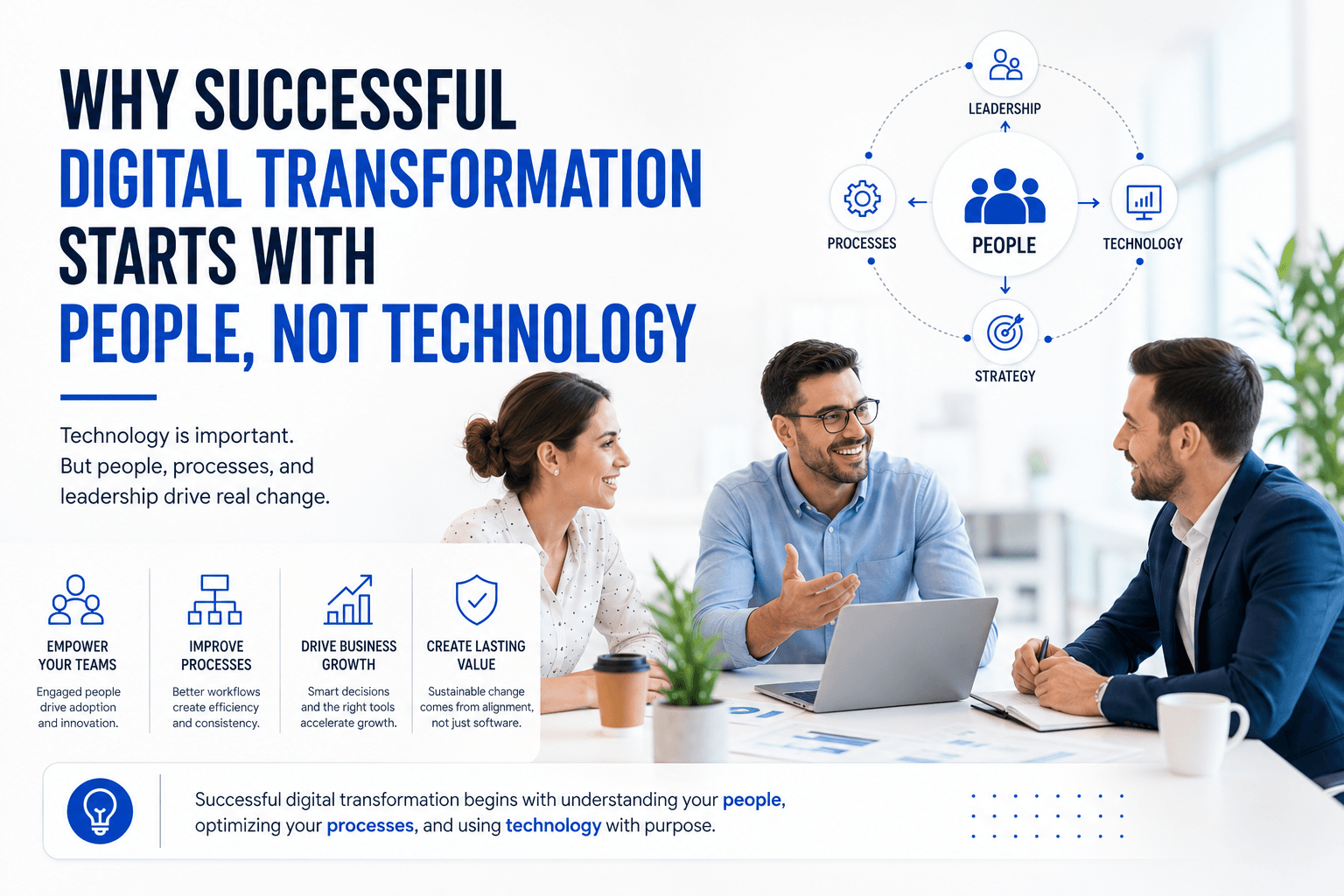
Successful digital transformation has never been about replacing existing ways of working with new technology. It is about improving the way an organization operates and using technology as the tool that enables that improvement.
Technology Doesn't Fix Broken Processes
One of the biggest misconceptions surrounding digital transformation is the belief that new technology can solve operational problems on its own. Businesses often assume that introducing a modern platform will automatically eliminate inefficiencies, improve communication, and increase productivity. While technology can certainly support these goals, it cannot fix processes that were already broken before implementation.
Imagine a company where customer enquiries pass through multiple departments before receiving a response. Each request requires several approvals, information is manually copied between different systems, and employees regularly wait for updates before moving work forward. Introducing a new customer relationship management system may improve how information is stored, but it will not remove unnecessary approvals or simplify communication if those underlying processes remain unchanged.
This is why many organizations feel disappointed after investing in new technology. The software performs exactly as intended, but employees continue experiencing the same frustrations because the business never addressed the real problem. Inefficient processes simply become digital versions of themselves.
Successful transformation begins by understanding how work flows through the organization. Business leaders should identify where delays occur, which tasks are repetitive, where communication breaks down, and how customers experience those inefficiencies. Only after gaining that understanding should technology become part of the solution.
When businesses improve their processes first, technology becomes an accelerator for positive change. Instead of creating additional complexity, it supports a more efficient way of working that employees can adopt with confidence.
Employees Determine Whether Transformation Succeeds
Every digital transformation project eventually reaches the same point.
The technology has been purchased, implementation has been completed, and employees are expected to begin using the new system.
This is where many organizations discover that successful transformation has very little to do with software and everything to do with people.
Employees are responsible for turning technology into measurable business value. If they understand why changes are being introduced, receive appropriate training, and see how the new system improves their daily work, adoption becomes much easier. On the other hand, when technology is introduced without communication or preparation, employees often return to familiar tools and manual processes because they feel more comfortable and productive.
Consider two businesses implementing the same project management platform. The first company simply announces the new software and expects teams to adapt immediately. The second explains the purpose of the change, provides training, gathers employee feedback throughout implementation, and gradually introduces new workflows. Although both organizations invested in the same technology, the second business is far more likely to achieve lasting success because it invested in the people responsible for using it.
Digital transformation is ultimately a change management initiative as much as it is a technology initiative. Businesses that support their employees throughout the transition create stronger adoption, better collaboration, and significantly greater returns from their technology investments.
Technology may introduce new capabilities, but people determine whether those capabilities become part of everyday business operations.
Digital Transformation Is a Business Strategy, Not an IT Project
One of the most common reasons digital transformation initiatives fall short is that they are treated as technology projects rather than business initiatives. Responsibility is often placed entirely on the IT department, while leadership assumes that selecting and implementing new software is enough to transform the organization. In reality, technology is only one part of a much larger picture.
Successful digital transformation begins with clearly defined business objectives. An organization might want to improve customer satisfaction, reduce operational costs, shorten delivery times, or provide employees with better tools to perform their work. These goals are business priorities, not technology priorities. Software, automation, and digital platforms simply provide the means to achieve them.
Consider a retail business that wants to improve its customer experience. Purchasing a new CRM platform may seem like the logical first step, but the software alone will not improve customer relationships. The business must also review how customer enquiries are handled, how quickly issues are resolved, how information is shared between departments, and how employees interact with customers throughout their journey. Only when these operational improvements are supported by technology does the investment begin delivering meaningful results.
This is why digital transformation should involve leadership, operations, customer service, marketing, finance, and technology teams working toward the same objective. Every department contributes to the customer experience and operational efficiency, making transformation a business-wide effort rather than a technical implementation.
Organizations that view digital transformation as a long-term business strategy often achieve more sustainable results because every technology decision supports broader organizational goals instead of existing as an isolated project.
Small Improvements Often Create the Biggest Results
Many businesses delay digital transformation because they believe it requires replacing every existing system or making a significant financial investment. The idea of transforming an entire organization can feel overwhelming, particularly for small and medium-sized businesses that already manage limited resources and busy operations.
In practice, successful transformation rarely happens all at once.
Some of the most valuable improvements come from solving one problem at a time. Automating a repetitive approval process, connecting two business systems that previously operated independently, simplifying customer onboarding, or providing employees with easier access to information can produce immediate benefits without disrupting the entire organization.
Imagine a company where sales representatives manually copy customer information from website enquiries into a CRM before notifying the operations team through email. Each enquiry requires several repetitive steps, increasing the likelihood of delays and data entry errors. By integrating the website with the CRM and automatically notifying the appropriate team, the business removes unnecessary manual work while improving both speed and accuracy.
Although this may appear to be a relatively small improvement, the long-term impact can be substantial. Employees spend less time performing administrative tasks, customers receive faster responses, and management gains more reliable information for decision-making.
Digital transformation should not be measured by the size of the technology investment. It should be measured by the value created through continuous improvement. Businesses that consistently make small operational enhancements often achieve stronger long-term results than organizations attempting large-scale transformation without a clear strategy.
Leadership Sets the Direction for Transformation
Technology can introduce new possibilities, but leadership determines whether those possibilities become meaningful business outcomes. Without clear direction from decision-makers, even the most advanced digital solutions struggle to deliver lasting value.
Leaders play a critical role in defining why transformation is necessary and how success will be measured. Employees are far more likely to support change when they understand the business objectives behind it rather than simply being asked to learn another system. Clear communication helps reduce uncertainty, encourages collaboration, and creates confidence that technology is being introduced to improve the way people work rather than make their roles more complicated.
Leadership is also responsible for creating a culture that embraces continuous improvement. Digital transformation is not a project with a fixed finish line. Customer expectations change, markets evolve, and new technologies continue to emerge. Businesses that remain successful are those that regularly evaluate their processes, listen to employee feedback, and adapt their operations when better opportunities become available.
This does not mean organizations should adopt every new technology trend. Effective leadership involves making thoughtful decisions based on business value rather than market excitement. The objective is not to become the most technologically advanced company in the industry. The objective is to become a more efficient, resilient, and customer-focused business.
When leadership provides a clear vision and encourages employees to participate in the transformation journey, technology becomes a powerful tool for achieving long-term strategic goals instead of simply another operational expense.
Final Thoughts
Digital transformation is often associated with modern software, artificial intelligence, cloud platforms, and automation. While these technologies undoubtedly play an important role, they are not what transform a business.
People transform businesses.
Employees improve processes, leaders establish direction, and organizations create cultures that encourage continuous learning and innovation. Technology simply provides the tools that make those improvements possible.
Businesses that focus exclusively on software frequently discover that transformation is slower and more difficult than expected because the underlying operational challenges remain unchanged. Those that begin by understanding how their teams work, identifying opportunities for improvement, and aligning technology with clear business objectives are far more likely to achieve meaningful and lasting results.
Successful digital transformation is not about replacing people with technology. It is about giving people better ways to work, collaborate, and deliver value to customers. When organizations place people, processes, and strategy at the centre of every technology decision, digital transformation becomes far more than a software implementation.
It becomes a sustainable approach to building a stronger, more adaptable, and future-ready business.
Share this article