Artificial intelligence has become much easier to add to software. A developer can connect an application to a large language model, send a prompt, receive a response, and have an AI-powered feature working within a short amount of time.
That accessibility has changed how businesses approach AI. What once required specialized research teams can now be prototyped using existing models and APIs.
But there is a significant difference between adding AI to an application and integrating AI into a business.
A prototype can demonstrate that a model can answer questions or generate content. A production system needs to work with real customers, real data, existing software, business rules, permissions, workflows, and operational constraints. That is where the integration gap begins.
The difficult part isn't necessarily getting AI to respond.
The difficult part is making AI work reliably inside the systems a business already depends on.
The API Call Is the Easy Part
Connecting an application to an AI model is relatively straightforward.
A request is sent to a model, some context is provided, and a response comes back. This makes the first stage of AI development feel surprisingly simple.
The challenge begins when the AI needs to do something meaningful with that response.
A customer-support assistant may need to retrieve an order from a database. A sales assistant may need to access CRM information. An internal assistant may need to search company documentation. An automation system may need to create records, update systems, or trigger workflows.
At that point, the AI is no longer operating independently.
It needs to become part of the existing technology ecosystem.
The API call was only the beginning.
AI Needs Business Context
General-purpose AI models have broad knowledge, but businesses operate on information that is specific to their environment.
A model may know how customer support generally works, but it doesn't automatically know your company's refund policy. It may understand how e-commerce works, but it doesn't know which products are currently in stock. It may understand financial terminology, but it doesn't automatically have access to your company's latest financial data.
This is where business context becomes essential.
AI systems need access to relevant information from the systems where that information actually exists. Depending on the application, that could include databases, knowledge bases, documents, APIs, CRM platforms, ERP systems, CMS platforms, or internal applications.
The quality of the AI experience is therefore closely connected to the quality of the information surrounding it.
A highly capable model with poor business context can still produce an unreliable result.
Your Existing Systems Don't Disappear Because AI Arrived
One of the misconceptions around AI adoption is that businesses can simply introduce a new AI layer and start from scratch.
Most businesses don't have that luxury.
They already have years of software, databases, APIs, integrations, workflows, and internal systems supporting their operations.
An AI application needs to work with that existing environment.
The CRM still exists. The ERP still exists. The customer database still exists. The payment system still exists. The internal APIs still exist.
AI becomes another layer that has to communicate with these systems.
This makes integration architecture extremely important.
The goal isn't to replace everything with AI.
The goal is to connect AI to the systems that already contain the information and capabilities the business needs.
Data Is Often Less Ready Than Expected
AI projects frequently expose problems that already existed inside an organization's data.
A company may have thousands of documents, but they may use inconsistent terminology. Customer information may exist across multiple systems. Product records may contain duplicates. Internal documentation may be outdated. Important business rules may exist only in emails or inside the knowledge of experienced employees.
AI doesn't automatically solve these problems.
In many cases, it makes them more visible.
If an AI system retrieves inaccurate or outdated information, the model may produce an answer that sounds convincing while still being wrong.
This is why AI integration often becomes a data-quality project as well.
Before asking AI to make better decisions, businesses need to understand whether the information available to it is reliable in the first place.
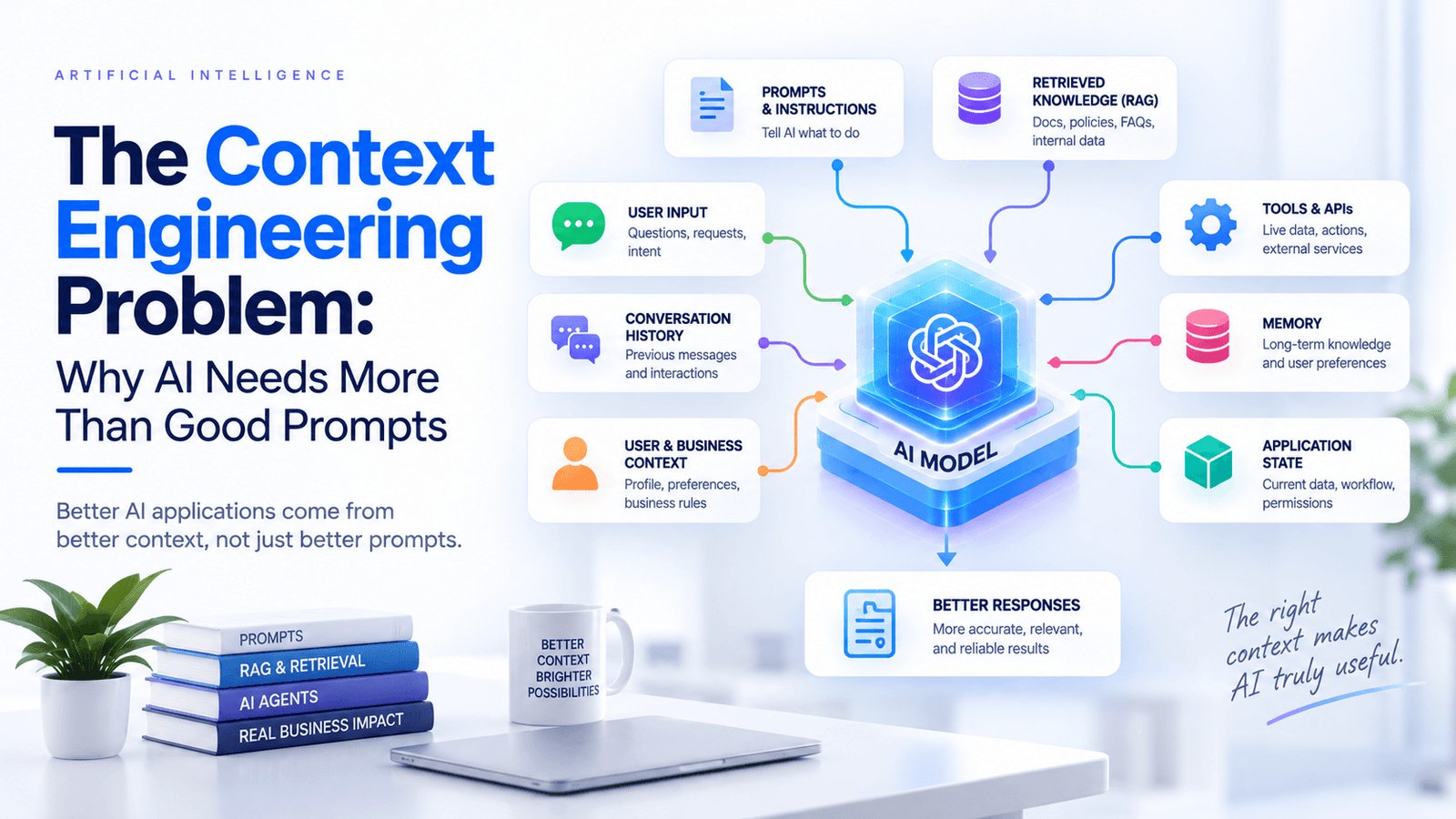
Context Needs an Architecture
Providing AI with business information isn't simply a matter of sending more data to the model.
The system needs to determine which information is relevant to the current task.
A support assistant dealing with a shipping question may need the customer's order, delivery status, shipping policy, and recent communication history. It probably doesn't need the company's entire knowledge base.
This makes retrieval and context management important parts of AI architecture.
The system needs to identify relevant information, retrieve it efficiently, and provide it to the model in a form that supports the task.
Too little context can lead to incomplete answers.
Too much irrelevant context can introduce noise, increase costs, and make it harder for the model to focus on what matters.
Good AI integration is therefore not about connecting AI to every data source.
It's about creating a reliable path to the right information at the right time.
Business Rules Can't Be Replaced by Prompts
AI is flexible, but businesses often depend on rules that need to be deterministic.
Consider a financial approval workflow.
An AI system may help understand a request, summarize information, or recommend an action. But the final decision may still need to follow explicit rules around authorization limits, compliance requirements, or risk thresholds.
The same applies to refunds, access permissions, pricing, account changes, and many other business processes.
A prompt saying "follow company policy" isn't necessarily enough.
Important business rules should exist in the application architecture where they can be validated and enforced consistently.
AI can help interpret information and make recommendations, but deterministic systems should continue to handle decisions where predictability and strict enforcement matter.
The strongest AI architectures don't try to make everything intelligent.
They combine probabilistic intelligence with deterministic engineering.
Permissions Become More Important
Traditional software usually operates according to permissions assigned to users or applications.
AI introduces another layer of complexity.
An AI assistant may be capable of retrieving information or taking actions on behalf of a user. But capability doesn't automatically mean authorization.
An employee may have access to certain customer information but not financial records. A support agent may be allowed to create a ticket but not issue a refund. An AI system may be allowed to prepare an action but require human approval before executing it.
These distinctions need to be designed into the system.
AI shouldn't simply inherit broad access because it needs to be useful.
It should operate within clearly defined permissions.
The more powerful the AI becomes, the more important those boundaries become.
AI Needs Controlled Access to Tools
Connecting AI to business systems often means giving it access to tools.
A tool might allow an AI system to search a database, retrieve an order, create a support ticket, update a CRM record, or call an external API.
This turns AI from a system that generates information into one that can actually perform work.
But every tool introduces another potential failure point.
The AI may choose the wrong tool. It may provide incorrect parameters. The external system may fail. The returned information may be incomplete. An action may have consequences that cannot easily be reversed.
Tool access therefore needs validation, authorization, error handling, and appropriate safeguards.
The model can decide that an action may be useful.
The application should still determine whether that action is allowed, valid, and safe to execute.
Legacy Systems Become Part of the AI Challenge
Many businesses operate on systems that were never designed with AI in mind.
They may have older APIs, proprietary databases, limited integration capabilities, or workflows that depend on manual processes.
That doesn't mean they are unusable.
It means an integration layer may be required.
AI systems can communicate through APIs, middleware, event-driven architecture, queues, adapters, or purpose-built services that translate between modern AI workflows and older systems.
This is an important reality of enterprise AI.
The future doesn't arrive on a clean technical slate.
AI has to work with the architecture businesses already have.
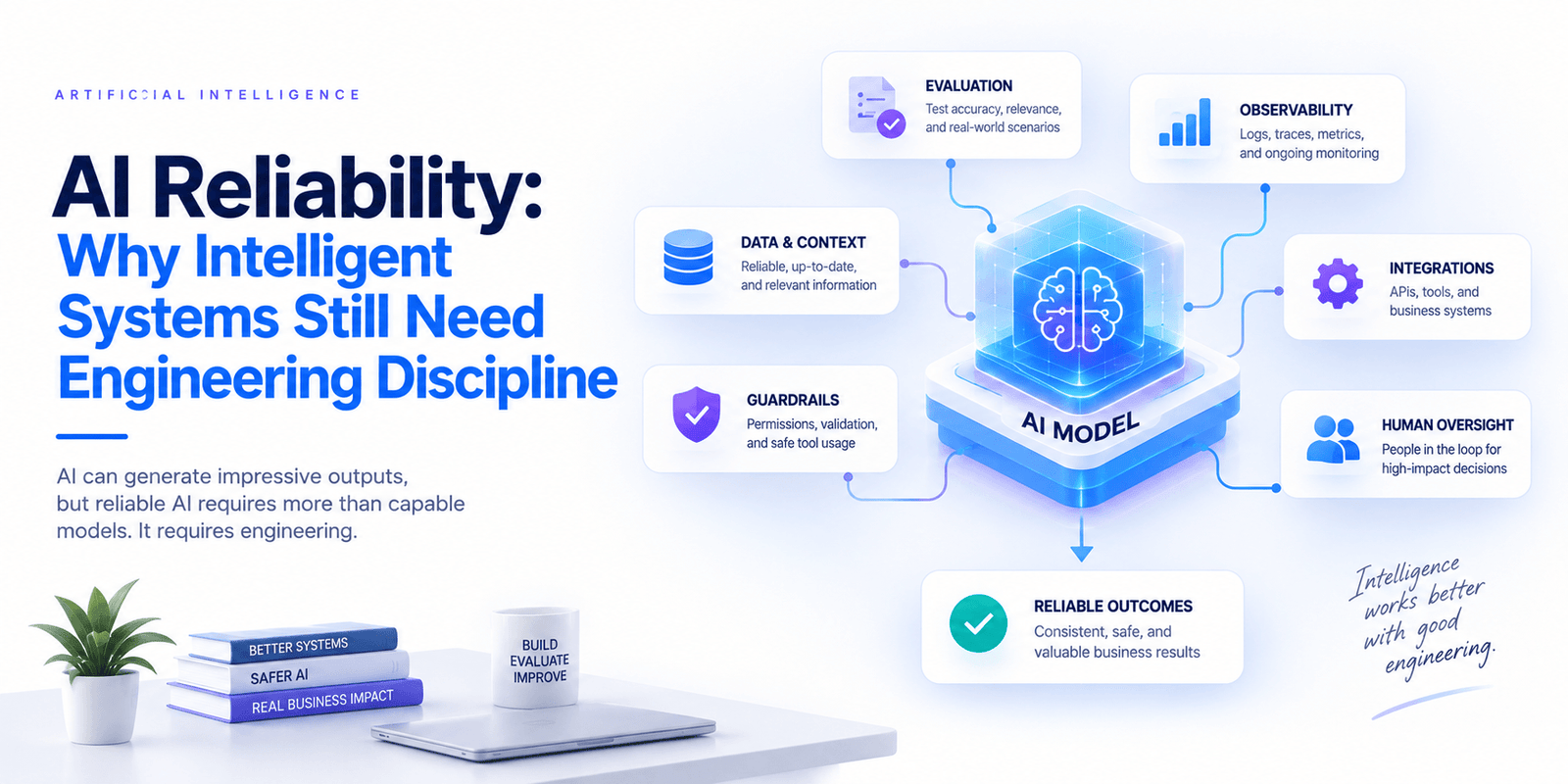
Reliability Is Different From Intelligence
A model can be highly intelligent and the overall AI application can still be unreliable.
Imagine an AI system that correctly understands a customer's request but retrieves outdated information from an internal database.
The reasoning may be excellent.
The answer is still wrong.
Or imagine an AI agent correctly identifies that it needs to update a CRM record, but the API fails halfway through the workflow.
The model made the right decision.
The system still failed.
This is why AI reliability needs to be considered at the system level.
Teams need to think about retrieval failures, API failures, timeouts, incorrect tool calls, incomplete data, unexpected inputs, model errors, and recovery strategies.
The model is only one potential source of failure.
Observability Becomes Part of Integration
When AI becomes connected to multiple business systems, understanding what happened becomes increasingly important.
A traditional application might log a request and response.
An AI workflow may involve several steps.
The system might retrieve documents, call a model, invoke a tool, receive data from an API, call the model again, validate the result, and finally perform an action.
If something goes wrong, developers need visibility into the entire chain.
Which context was retrieved?
Which model was used?
Which tools were called?
What did those tools return?
Where did the workflow fail?
How much latency and cost did the request generate?
Without this visibility, troubleshooting becomes difficult.
AI observability therefore needs to cover not just infrastructure, but the behaviour of the AI workflow itself.
Integration Changes the Role of APIs
APIs have always connected different software systems.
AI makes them even more important.
An AI application often needs APIs to access business capabilities rather than simply retrieving static information.
The CRM API becomes a customer-information tool.
The inventory API becomes a stock-checking capability.
The payment API becomes a transaction capability.
The support API becomes a ticket-management capability.
This means existing APIs may become part of the interface between AI and the business.
It also places greater importance on API design.
Clear contracts, predictable responses, validation, authentication, error handling, and well-defined capabilities make it easier to integrate AI safely.
The better the underlying interfaces are designed, the easier it becomes to connect intelligent systems to them.
Human Approval Still Has a Place
Not every AI action should happen automatically.
Some workflows are low-risk and highly repetitive. Others can affect money, customers, legal obligations, security, or important business decisions.
In those situations, human approval can become an important part of the architecture.
AI might gather the information, analyse the situation, prepare a recommendation, and generate the required action.
A person can then review and approve it.
This approach allows businesses to benefit from AI automation without immediately handing complete control of critical workflows to an AI system.
The objective isn't maximum autonomy.
It's appropriate autonomy.
The right amount depends on the consequences of the action and the level of confidence the system can provide.
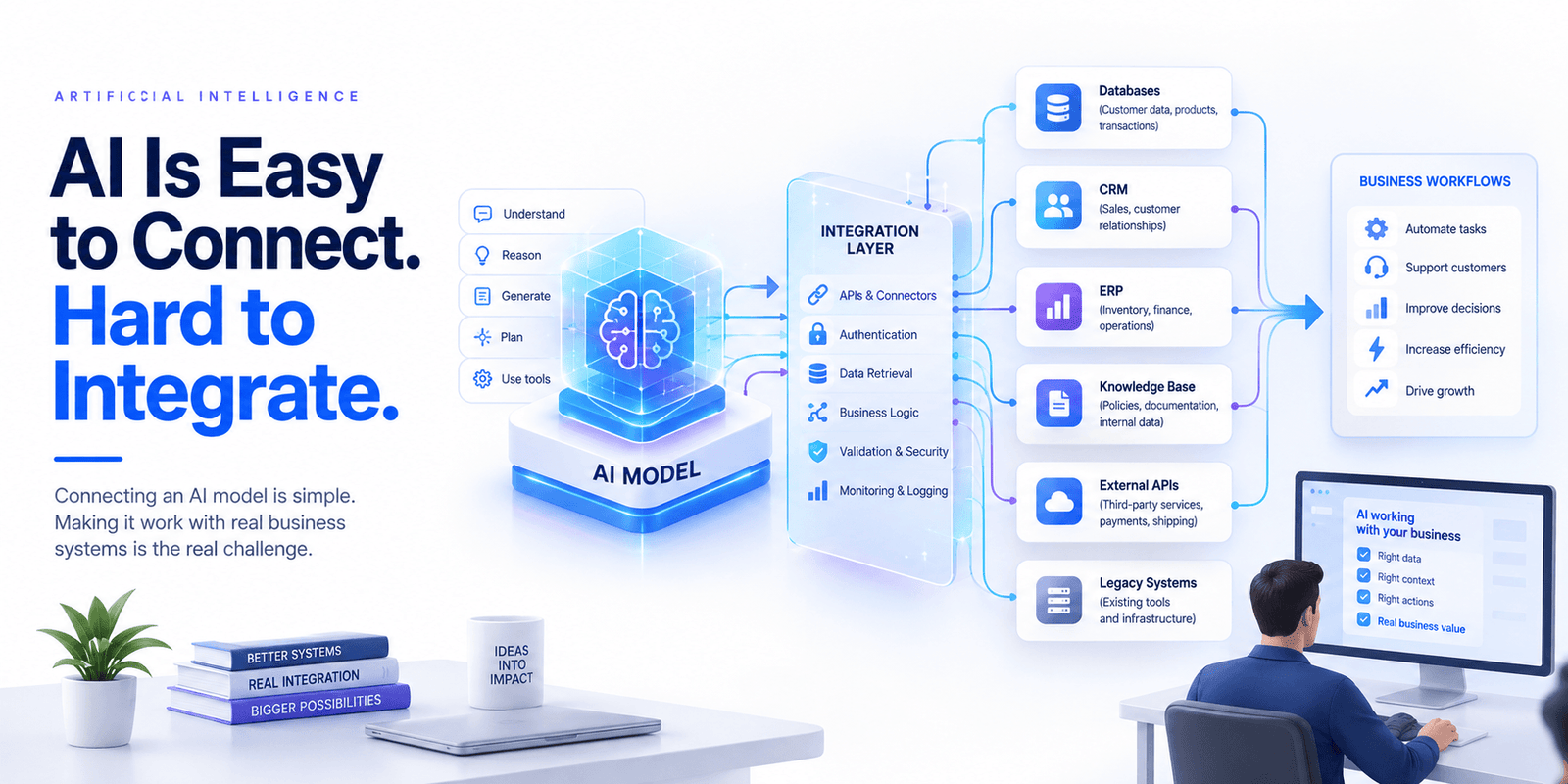
The Integration Layer Becomes a Strategic Asset
As AI becomes more deeply connected to business systems, the integration layer itself becomes increasingly important.
It can manage authentication, permissions, retrieval, tool access, validation, orchestration, logging, error handling, and communication between AI systems and existing applications.
This layer can also provide a controlled boundary between probabilistic AI behaviour and deterministic business systems.
Instead of allowing every AI feature to connect directly to every internal system, businesses can create structured interfaces through which AI capabilities are exposed.
That approach makes the architecture easier to manage and evolve.
It also means that improvements to the AI model don't necessarily require rebuilding every business integration.
AI Adoption Is Ultimately a Systems Problem
The excitement around AI often focuses on the model.
Which model is more capable?
Which model is faster?
Which model has better reasoning?
Those questions matter.
But once AI enters a real business environment, another set of questions becomes more important.
Can it access the right data?
Can it interact with existing systems?
Can its actions be controlled?
Can the results be evaluated?
Can failures be detected?
Can permissions be enforced?
Can the system operate at an acceptable cost?
Can it scale with the business?
These are architecture questions.
And they are often more difficult than choosing a model.
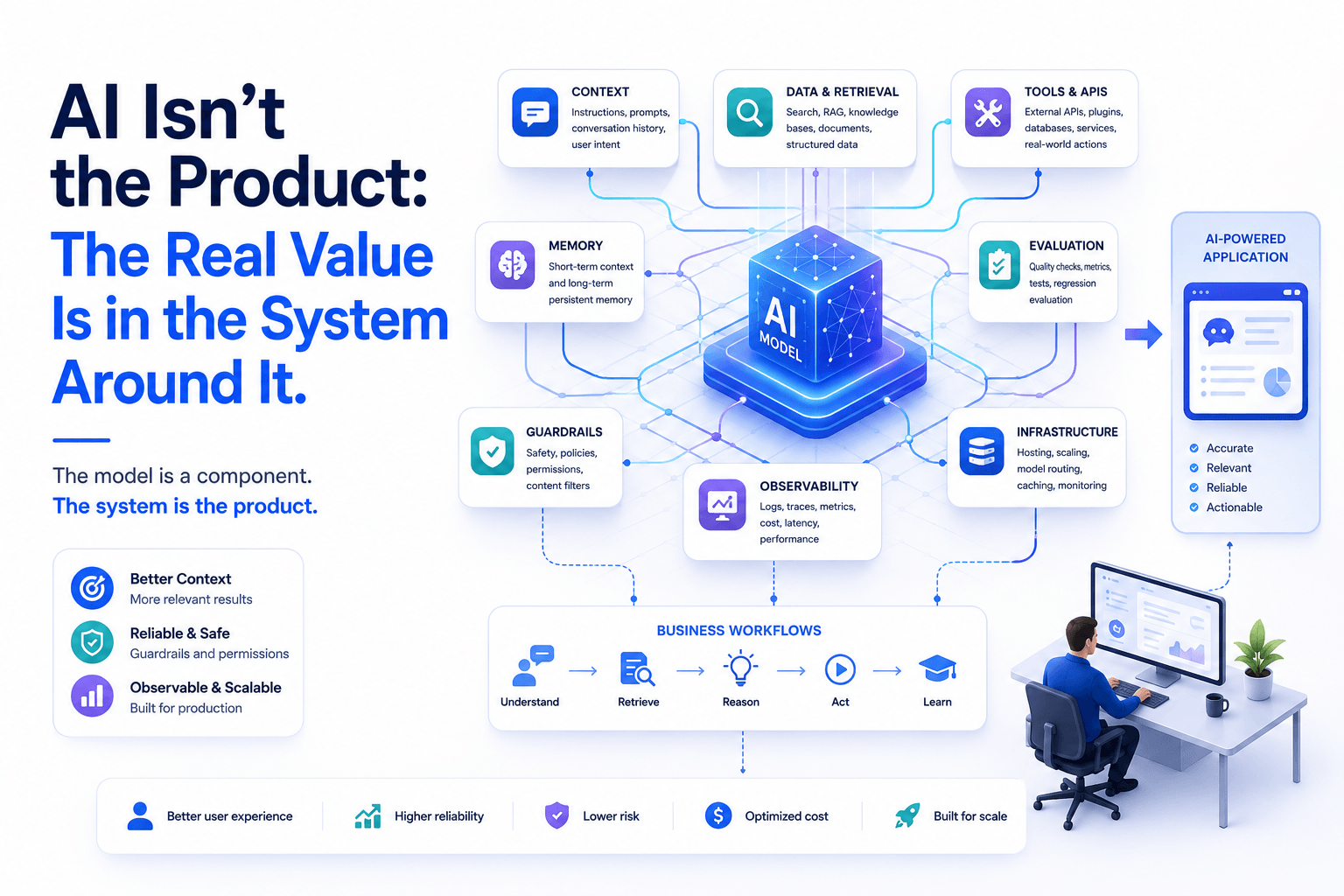
From AI Prototype to Business System
The journey from an AI prototype to a production system usually involves adding layers around the model.
The prototype demonstrates that the model can perform a task.
The production system connects that capability to real data.
Then it connects to business tools.
Then permissions and guardrails are introduced.
Evaluation is added.
Observability is added.
Failure handling is added.
Performance and cost are optimized.
Finally, the AI capability becomes part of an actual business workflow.
That is when AI stops being an isolated experiment and becomes part of the organization's technology infrastructure.
The model hasn't necessarily changed dramatically.
The system around it has.
Final Thoughts
Connecting an AI model to an application is becoming easier.
Connecting that AI to a real business is a different challenge.
Businesses operate through complex ecosystems of data, applications, APIs, rules, permissions, workflows, and people. AI has to fit into that ecosystem rather than exist separately from it.
The most successful AI implementations will therefore not simply ask what a model can generate.
They will ask what the model can reliably do when connected to the right systems, data, tools, and workflows.
That requires more than prompts.
It requires architecture.
The future of enterprise AI won't be defined only by increasingly capable models. It will also be defined by how effectively those models are integrated into the systems that businesses already rely on.
AI doesn't replace your existing architecture. It becomes another layer that has to work with it.
Share this article