Artificial intelligence has become remarkably good at producing useful outputs. Modern models can summarize documents, write code, analyze information, answer questions, generate content, and even take actions through connected tools. What makes this impressive is also what makes AI systems fundamentally different from traditional software: the same input does not always guarantee exactly the same output.
That unpredictability is not necessarily a flaw. In many applications, it is part of what makes AI useful. But it creates a different engineering challenge when AI moves from experimentation into production.
A chatbot that occasionally gives an imperfect answer during an internal experiment is one thing. An AI system that makes recommendations for customers, processes business information, updates records, or triggers operational workflows is something else entirely. Once AI becomes part of a real business process, reliability matters just as much as intelligence.
The question is therefore no longer simply “How capable is the model?”
It becomes:
“How reliably can we build a system around that model?”
AI Reliability Is Different From Traditional Software Reliability
Traditional software is generally built around deterministic rules. If the same conditions are provided, the system is expected to produce the same result.
AI systems introduce another layer of uncertainty. A model can interpret the same request differently depending on context, retrieved information, previous conversation, model version, or even small changes in the prompt.
This doesn't mean AI systems cannot be reliable. It means reliability has to be engineered differently.
Instead of expecting every output to be perfectly predictable, production AI systems need mechanisms that make unpredictable behavior detectable, controllable, and recoverable.
That changes the role of engineering. Developers are no longer responsible only for building the path from input to output. They also need to design what happens when the output is incomplete, incorrect, uncertain, or outside the expected boundaries.
A Good AI Response Is Not Necessarily a Reliable One
One of the easiest mistakes in AI development is evaluating a system based on a handful of impressive examples.
A model may answer ten test questions correctly and still fail badly when exposed to real-world inputs. It might misunderstand an unusual request, use the wrong piece of context, invent information, or produce an answer that sounds convincing but is factually incorrect.
This is why “it works” is a weak definition of AI quality.
Reliable AI requires systematic evaluation.
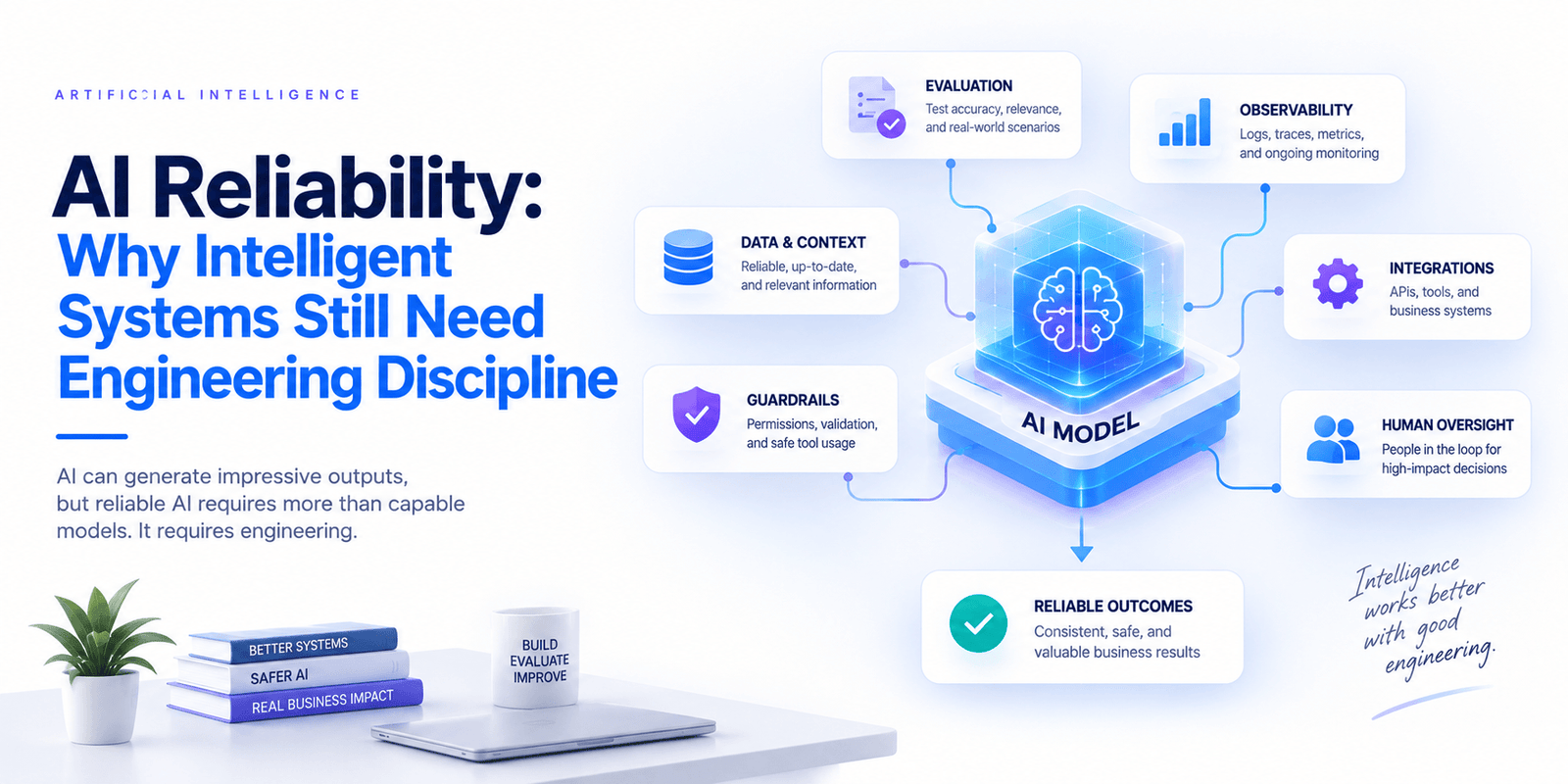
Teams need to test representative scenarios, edge cases, failure conditions, and business-critical workflows. Depending on the application, evaluation may include factual accuracy, relevance, consistency, tool usage, policy compliance, response quality, latency, and cost.
The important shift is from evaluating individual outputs to evaluating system behavior over time.
An AI feature should not be considered reliable simply because it performed well during development. Its behavior needs to be measured continuously as models, prompts, data, integrations, and business requirements change.
Observability Becomes Essential
Traditional applications already require logs, metrics, traces, and monitoring. AI applications need those capabilities too, but they also need visibility into the reasoning process around the model.
For example, if an AI agent gives an incorrect answer, knowing that the request returned a 200 OK tells you almost nothing.
Engineers may need to understand:
What input did the model receive?
What context was retrieved?
Which tools were called?
What data was returned by those tools?
Which model and prompt version were used?
How long did each step take?
What did the model ultimately produce?
Was the output validated before reaching the user?
Without this information, debugging AI becomes guesswork.
Observability turns an AI system from a black box into something engineers can investigate. It also makes it possible to identify patterns that aren't visible from individual interactions—for example, a gradual increase in failed tool calls, declining retrieval quality, rising latency, or a particular workflow generating consistently poor outputs.
Guardrails Are Part of the Architecture
A common misconception is that a sufficiently capable model can simply be instructed to behave correctly.
In production systems, prompts should not be treated as the only line of defense.
If an AI application can access customer information, execute business operations, or interact with external systems, the surrounding architecture needs to enforce boundaries independently of the model.
That can include permission controls, structured tool interfaces, validation rules, output filtering, rate limits, approval steps, and restrictions on what actions an agent can perform.
For example, an AI assistant might be allowed to prepare a refund request but not automatically issue the refund. Another system might allow an agent to retrieve customer information but prevent it from accessing sensitive financial data.
The principle is simple:
AI should operate within engineered boundaries, not define its own boundaries.
Handling Uncertainty Instead of Hiding It
One of the most important characteristics of reliable AI systems is knowing when not to pretend to know.
Large language models are optimized to generate useful responses, but that doesn't guarantee that every response is supported by reliable information. In business environments, confidently presenting an uncertain answer can be significantly worse than admitting uncertainty.
This is why production AI systems often need explicit strategies for uncertain situations.
An application might:
request additional information from the user,
retrieve information from an authoritative source,
ask for human approval,
return a limited response,
or decline to perform an action.
The goal isn't to eliminate uncertainty. That is unrealistic.
The goal is to manage uncertainty safely.
A reliable AI system knows that “I don't have enough information to proceed” can sometimes be a better outcome than generating a confident but incorrect answer.
Human-in-the-Loop Isn't a Failure of AI
There is sometimes an assumption that a truly advanced AI system should operate without human involvement.
In reality, human oversight can be an important part of good system design.
Not every decision has the same level of risk. An AI system recommending blog topics can operate with relatively little oversight. An AI system approving financial transactions, changing customer records, or making decisions with significant business consequences requires a much more controlled workflow.
The right approach is therefore not simply AI versus humans.
It is deciding where human judgment provides the most value.
AI can handle high-volume, repetitive, or low-risk decisions while escalating ambiguous or high-impact cases to people. This creates systems where automation and human expertise complement each other rather than compete.
AI Systems Change When Their Components Change
Another reliability challenge comes from the fact that AI applications are rarely static.
A production AI system may depend on a model, system prompt, retrieval pipeline, vector database, business data, APIs, tools, and external services. Changing any of these components can influence the final behavior.
A new model version may produce different outputs. A change to the retrieval strategy may alter the context provided to the model. A modified prompt may improve one workflow while degrading another.
This makes versioning and regression testing increasingly important.
AI systems need the same engineering discipline applied to other production software: controlled changes, testing environments, version tracking, deployment processes, and the ability to identify what changed when behavior changes.
The difference is that testing AI isn't only about whether the application crashes.
It's also about whether the quality and behavior of its decisions remain within acceptable boundaries.
Reliability Is an Ongoing Process
AI reliability isn't something a team achieves once and then checks off a project plan.
Models evolve. Business data changes. Users behave differently. New edge cases appear. Integrations change. Prompts are refined. Business rules are updated.
A reliable AI system therefore needs a continuous improvement loop:
Build → Evaluate → Deploy → Observe → Learn → Improve
This is one of the biggest differences between an AI demo and a production AI capability.
A demo proves that something is possible.
A production system needs to prove that it can continue working when conditions are no longer perfect.
Engineering Discipline Still Matters
The rapid progress of AI can create the impression that better models will eventually solve most reliability problems.
Better models certainly help. But model capability is only one part of the equation.
A highly capable model connected to poor data, weak permissions, unreliable APIs, inadequate monitoring, and undefined business rules can still produce an unreliable system.
Conversely, a well-engineered system can make useful AI capabilities considerably more dependable by controlling context, validating outputs, limiting actions, monitoring behavior, and involving humans when necessary.
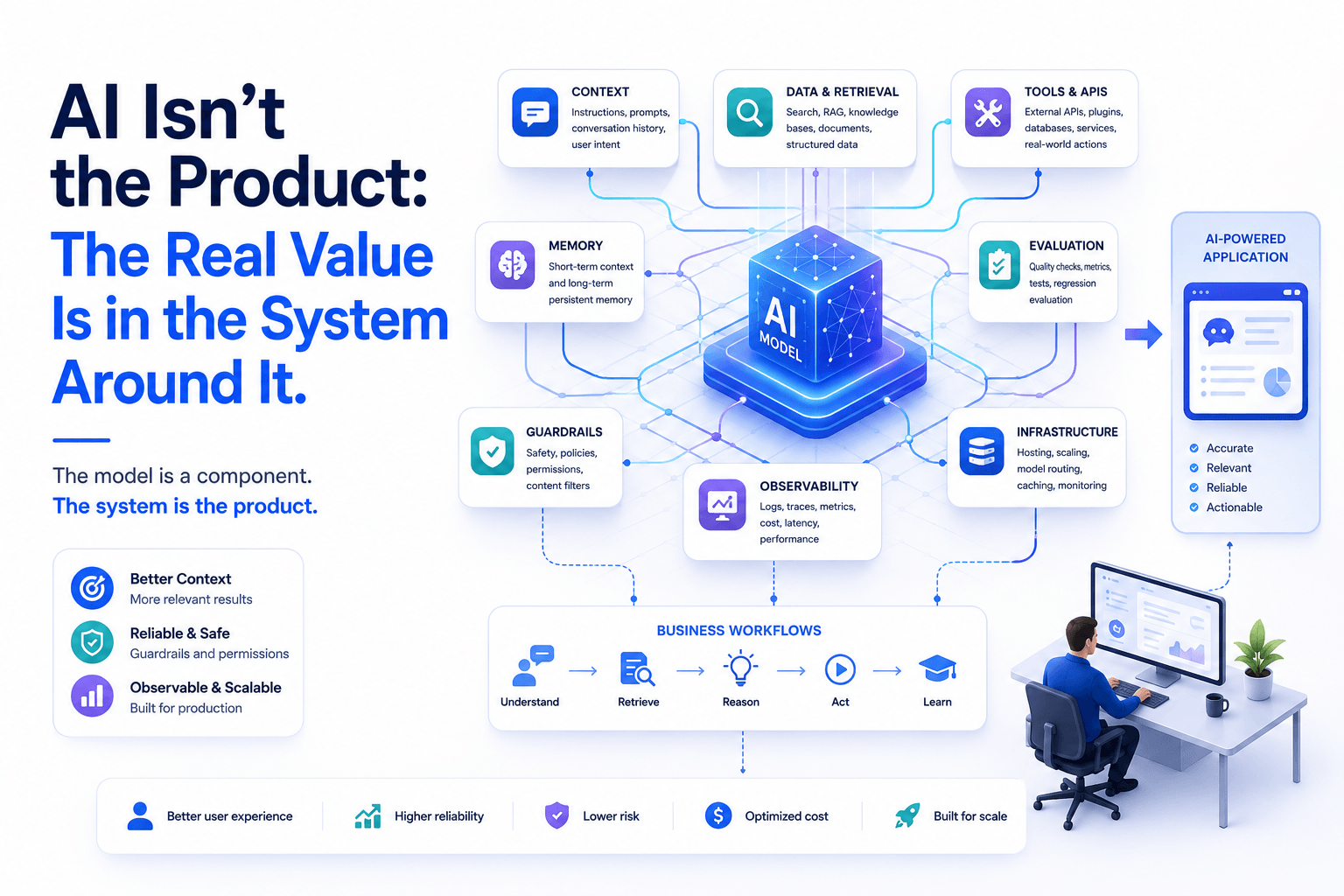
This is why AI engineering is increasingly becoming a systems discipline.
The competitive advantage isn't necessarily having access to the most powerful model. Many organizations can access similar models.
The advantage comes from how effectively a business can turn model capabilities into reliable operational systems.
The Future of AI Depends on Reliability
AI adoption is moving beyond isolated experiments and chat interfaces. AI is increasingly being connected to business applications, internal data, customer workflows, automation platforms, and operational systems.
As that happens, reliability becomes a business requirement rather than simply an engineering preference.
Companies won't just ask whether an AI system can perform a task.
They will need to ask:
Can we measure how well it performs?
Can we understand when it fails?
Can we control what it is allowed to do?
Can we recover when something goes wrong?
Can we improve it without introducing new problems?
These questions define whether AI is ready to become part of a critical business process.
The goal isn't to make AI perfectly predictable. AI will continue to have uncertainty, variation, and limitations.
The goal is to build systems that remain dependable despite those limitations.
Conclusion
AI intelligence is improving faster than ever, but intelligence alone doesn't create reliability.
Reliable AI comes from the engineering surrounding the model: evaluation, observability, validation, permissions, guardrails, human oversight, controlled deployments, and continuous improvement.
The most successful AI systems will not simply be the ones with the smartest models. They will be the ones designed to handle uncertainty responsibly and operate consistently within real-world constraints.
An AI system isn't production-ready when it can produce a good answer. It's production-ready when you can understand, evaluate, control, and improve its behavior.
Share this article