Imagine arriving at work on a Monday morning and discovering that your team completed the same amount of work as last week—but in half the time. Customer enquiries were answered faster, reports were prepared automatically, meeting notes had already been summarized, and routine administrative tasks that once consumed hours had been completed before the day even began.
For many businesses, this isn't a glimpse into a distant future. It's already becoming part of everyday operations.
Artificial intelligence is often discussed as though it's replacing people, eliminating jobs, or completely transforming industries overnight. Those headlines attract attention, but they don't reflect what most businesses are actually experiencing. The biggest impact of AI isn't that employees are disappearing—it's that repetitive work is.
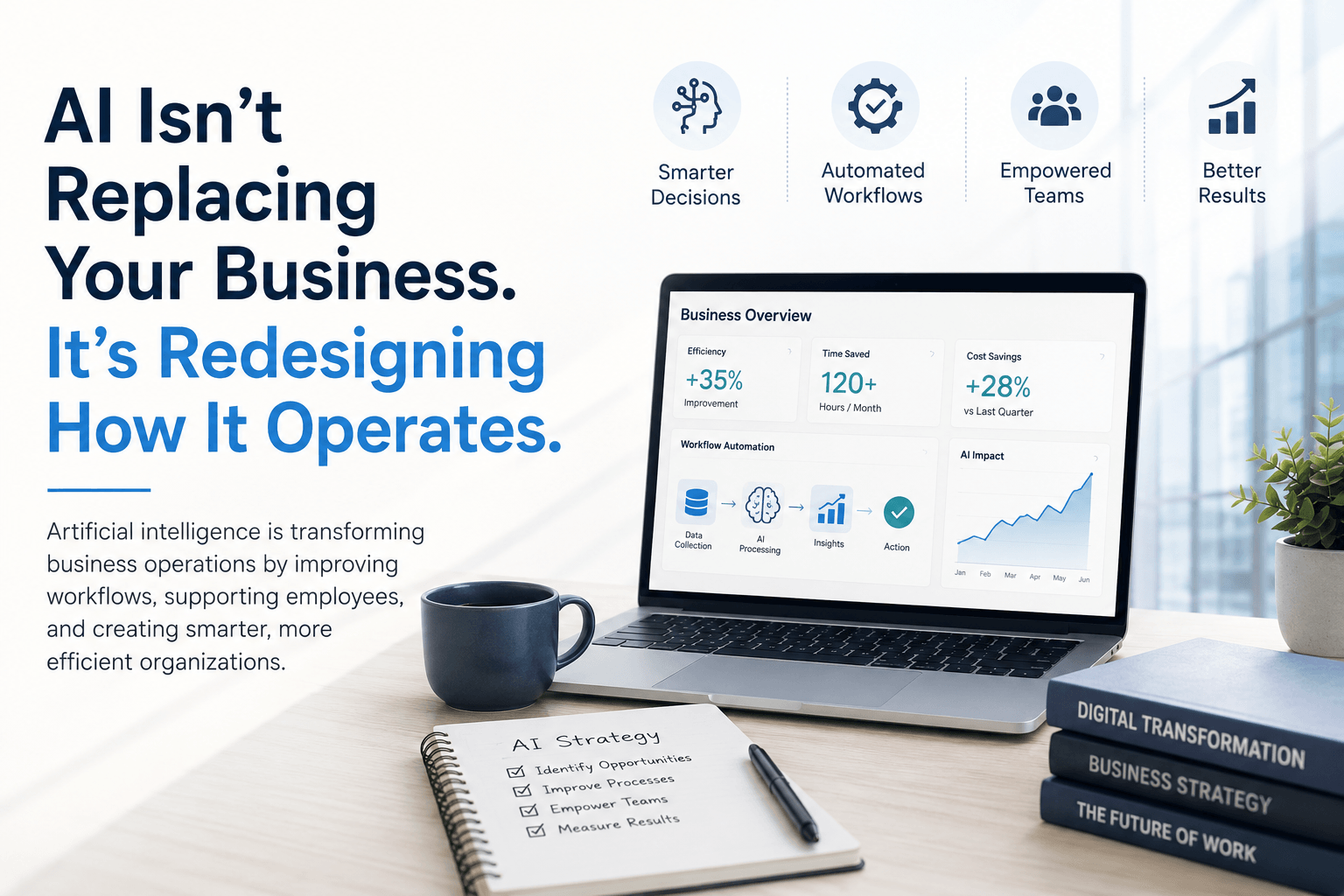
Across every department, businesses rely on processes that consume valuable time without creating meaningful value. Teams manually organise information, move data between systems, prepare reports, answer similar customer questions, and perform countless administrative tasks that are essential but repetitive. Artificial intelligence is changing these workflows by reducing the effort required to complete them, allowing employees to focus on work that benefits from experience, creativity, and sound judgement.
This shift is changing how businesses operate, not what businesses are. Organisations that recognise this distinction are approaching AI very differently from those simply trying to adopt the latest technology trend. Rather than asking how much AI they can introduce, they're asking where AI can create the greatest impact.
AI Is Changing How Work Gets Done
Much of the discussion around artificial intelligence focuses on whether it will replace specific professions. Developers, marketers, designers, accountants, and customer support teams are all part of this conversation. While it's natural to wonder how technology will influence different careers, the more significant change is happening within the work itself.
Take customer support as an example. Traditionally, responding to an enquiry required an employee to review the customer's message, search internal documentation, check previous conversations, and carefully prepare a response. Each individual task might only take a few minutes, but when repeated hundreds of times every week, the amount of time invested becomes significant.
Today, artificial intelligence can assist throughout that workflow. It can summarise previous conversations, locate relevant documentation, recommend responses based on company policies, and draft replies that employees can review before sending. The support specialist remains responsible for accuracy, empathy, and complex decision-making, but much of the repetitive work has already been completed.
The same pattern is emerging across software development, sales, finance, marketing, and operations. AI is not removing the need for experienced professionals; it's allowing them to spend less time on routine tasks and more time applying the expertise that helps businesses grow. That distinction is important because it shifts the conversation from replacement to productivity.
AI Doesn't Replace Expertise. It Amplifies It.
One of the reasons artificial intelligence creates so much uncertainty is that it's often presented as a replacement for human expertise. Headlines frequently suggest that developers, designers, writers, accountants, and even business leaders will eventually be replaced by increasingly capable AI systems. While these predictions generate attention, they oversimplify the way businesses actually operate.
Every successful organisation depends on knowledge that extends far beyond information stored in documents or databases. It relies on experience gained over years of solving problems, understanding customers, adapting to changing markets, and making decisions when there isn't a clear right or wrong answer. These are areas where human judgement continues to play a critical role.
Consider a software development team building a custom application for a client. Artificial intelligence can generate code, explain unfamiliar programming concepts, identify potential bugs, and even recommend improvements based on established best practices. These capabilities allow developers to work faster and reduce time spent on repetitive tasks. However, AI doesn't understand the client's long-term business objectives, how different departments will use the software, or which architectural decisions will support future growth. Those decisions require conversations, critical thinking, and an understanding of the business itself.
The same principle applies in almost every industry. An accountant doesn't simply produce financial reports; they help business owners understand what those numbers mean and how they should influence future decisions. A marketing specialist doesn't just create content; they develop campaigns that reflect a company's brand, audience, and objectives. Customer service representatives do more than answer questions—they build trust, resolve complex issues, and create experiences that encourage customers to return.
Artificial intelligence can assist each of these professionals by reducing the administrative work surrounding their roles, but it cannot replace the judgement, creativity, and relationship-building that define genuine expertise. In many cases, AI actually increases the value of experienced professionals because it allows them to spend less time on repetitive activities and more time applying the knowledge that differentiates their business.
Rather than viewing AI as a competitor, organisations should see it as a tool that strengthens the capabilities of their teams. The businesses that gain the greatest advantage won't necessarily have the most advanced AI systems. They'll have employees who understand how to combine technology with experience to make better decisions, solve problems more effectively, and deliver greater value to customers.
AI Is Only as Effective as the Processes Behind It
Many businesses begin their AI journey by evaluating software platforms, comparing features, and watching product demonstrations. While choosing the right technology is important, the success of an AI initiative depends far less on the platform itself than on the environment in which it's introduced.
Artificial intelligence learns from the information and processes it is given. If customer records are incomplete, documentation is outdated, or information is scattered across multiple disconnected systems, AI will inevitably produce inconsistent or unreliable results. The technology hasn't failed—it has simply reflected the quality of the business processes supporting it.
Imagine a company implementing an AI-powered customer support assistant. The expectation is that customers will receive accurate answers more quickly, reducing the workload on the support team. However, if the assistant is trained using outdated documentation, inconsistent product information, and incomplete knowledge articles, customers may receive incorrect advice or conflicting responses. Instead of improving the customer experience, the business now has to spend additional time correcting mistakes and rebuilding trust.
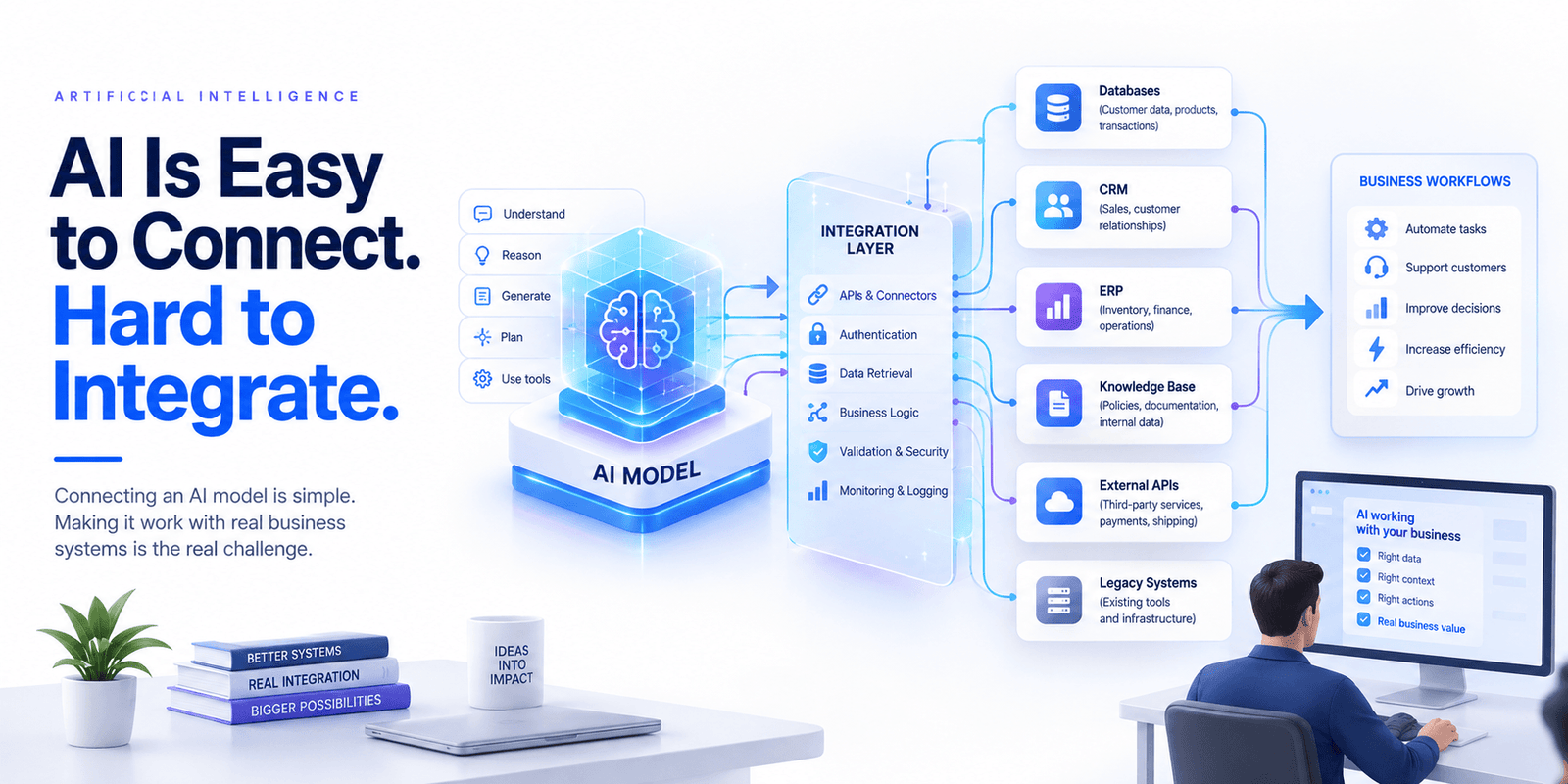
This is why organisations that see the strongest results from AI often invest in their operational foundations before expanding their AI capabilities. They improve the quality of their data, standardise internal documentation, connect business systems, and eliminate unnecessary complexity from existing workflows. These improvements not only make artificial intelligence more effective but also benefit employees who rely on the same information every day.
Preparing a business for AI is therefore not just a technology project. It's an operational improvement initiative. Businesses with well-organised processes, reliable information, and connected systems are in a much stronger position to benefit from artificial intelligence than those hoping AI will solve problems that already exist within the organisation.
For this reason, business leaders should view AI as part of a broader strategy to improve the way work is performed. Technology delivers its greatest value when it enhances strong processes rather than attempting to compensate for weak ones. AI is no exception. The better the foundation, the greater the results.
Businesses Should Start With a Strategy, Not an AI Tool
One of the biggest reasons AI initiatives fail isn't because the technology isn't capable. It's because businesses often begin with the wrong objective.
A leadership team attends a conference, watches a product demonstration, or reads about a competitor using artificial intelligence. The excitement is understandable, and before long the conversation becomes focused on choosing an AI platform rather than identifying the business problem that needs to be solved.
This approach usually leads to disappointment.
Employees are expected to adopt another piece of software without understanding why it's being introduced. Existing processes remain unchanged, productivity doesn't improve in meaningful ways, and leadership begins questioning whether the investment was worthwhile.
Businesses that achieve lasting success with AI usually take a different approach.
Instead of asking, "Which AI platform should we buy?", they ask questions that are much more closely connected to the way their business operates.
Where are employees spending the most time on repetitive work?
Which processes regularly create delays?
Where do mistakes occur most often?
What information takes too long to find?
How can customers receive faster and more consistent service?
These questions rarely produce a single answer, but they reveal something much more valuable: opportunities where artificial intelligence can support measurable improvements.
For one business, that opportunity might be reducing the time required to respond to customer enquiries. For another, it could involve automatically summarising meetings, improving internal knowledge management, or helping employees analyse operational data more efficiently. Every organisation is different, which is why successful AI adoption rarely follows the same path twice.
Starting with one well-defined objective also allows businesses to learn without introducing unnecessary disruption. Teams become comfortable working alongside AI, leadership gains a clearer understanding of its strengths and limitations, and future investments are based on real experience rather than assumptions.
Artificial intelligence should become part of a long-term business strategy, not a short-term reaction to industry trends.
Final Thoughts
Artificial intelligence is undoubtedly changing the way businesses operate, but not in the way many people expected. The most significant transformation isn't happening because organisations are replacing entire departments or removing the need for experienced professionals. It's happening because businesses are finding better ways to complete the work that supports their daily operations.
Across every industry, employees spend countless hours searching for information, preparing reports, responding to routine enquiries, moving data between systems, and completing administrative tasks that add little strategic value. Artificial intelligence is helping organisations reduce that burden, allowing people to focus on work that requires creativity, critical thinking, collaboration, and sound judgement.
The businesses that benefit most from AI won't necessarily be the first to adopt every new tool or the ones with the largest technology budgets. They'll be the organisations that understand their own operations, invest in strong processes, maintain reliable data, and introduce AI where it creates measurable improvements for both employees and customers.
Like every major technological shift before it, artificial intelligence isn't changing what makes a successful business. Companies will still compete on the quality of their products, the strength of their customer relationships, the expertise of their teams, and their ability to solve real problems. AI simply gives those businesses an opportunity to achieve those goals more efficiently.
The question is no longer whether artificial intelligence will become part of modern business. In many industries, it already has.
The more important question is whether businesses will use AI to chase trends or to build stronger, more efficient organisations for the future.
Share this article